


Welcome to Issue No. 014 of Sojourn. An independent publication delivering strategic interpretation for leaders shaping the future of travel and hospitality.
On Sunday I wrote on LinkedIn about the structural difference between building from demand and building from place. This is where it gets structural.
Interpretation: The hospitality industry has a replication problem, not because properties ‘copy’ each other deliberately, but because the logic driving most development leads somewhere predictable. When you start with demand signals, you arrive at similar answers. Similar answers produce similar properties. And similar properties compete on the same variables: price, amenities, location, star rating. That competition is winnable, but it is never finished. There is always another property entering the same field.
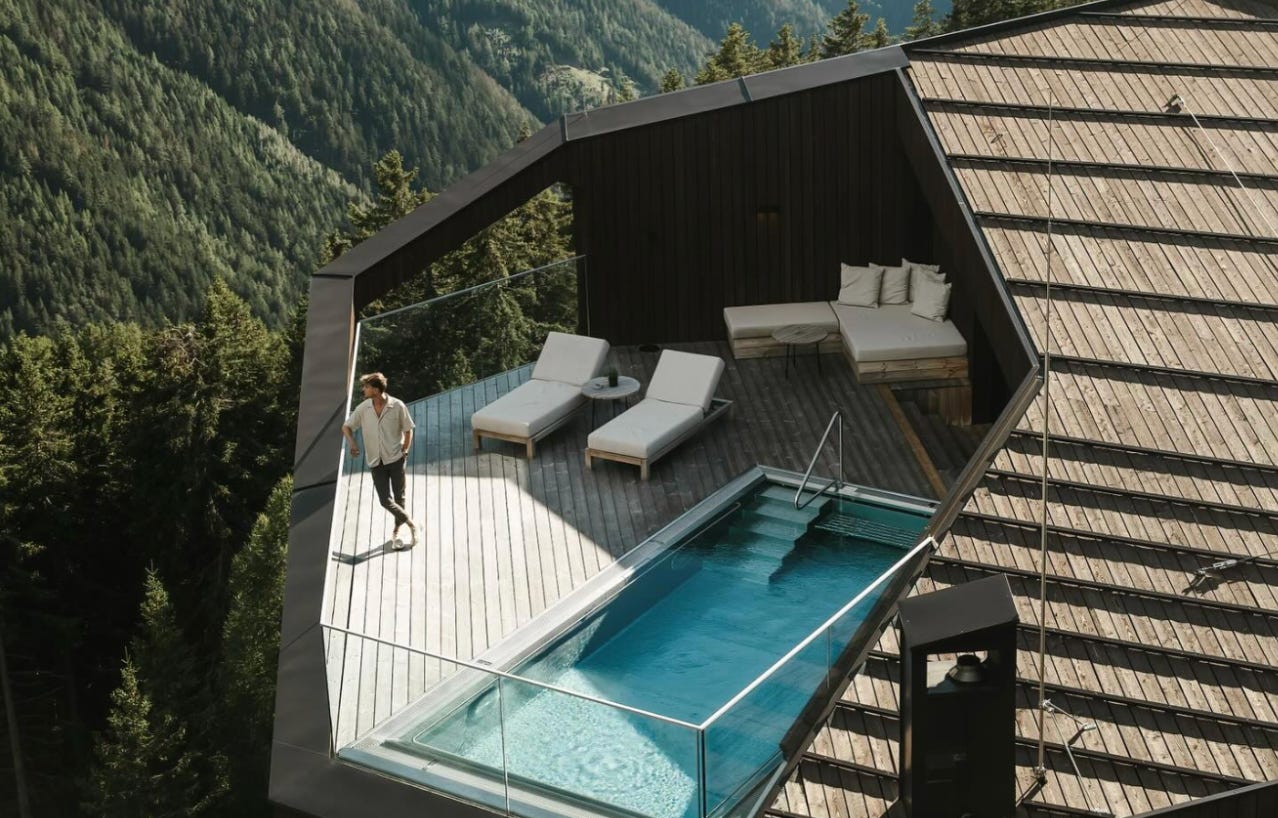
A smaller number of properties operate differently. They aren’t built around what the market wants. They’re built around a clear internal position, a point of view about what a place should be, how it should feel, and who it is genuinely for. FORESTIS in the Dolomites took eight years to open because the founders were working from that kind of position. So did Amangiri, which was designed around the specific silence and scale of the Utah desert. So did Fogo Island Inn, which was built not to attract tourism but to sustain a community, and became one of the most sought-after stays in the world precisely because that intention is legible in everything it does.
What strikes me about all three is that none of them felt rushed. You can sense it when you're there, or even just reading about them. There's a patience in the bones of the place that most development simply doesn't allow for.
What makes replication impossible: Features can be copied. Atmosphere can be staged. Programming can be replicated within a season. But the internal position that generates those decisions cannot be transferred. It isn’t a formula. It’s a consequence of specific choices made over time, about what to include, what to remove, and what the place is willing not to be. That clarity accumulates. And it becomes structurally impossible to imitate because it isn’t a surface. It’s a foundation.
I think about this a lot when I see new openings that look right but feel hollow. The design is there. The concept is there. But the position isn't. And you feel the absence immediately.
Paid subscribers, the inbox is open. Questions, follow-ups, or a topic you’d like me to look at — reply to any issue. I read every email.
What this produces: When a property is built from a clear position, guests stop comparing it against alternatives the way they compare conventional options. Comparison requires similarity. When similarity is absent, the decision simplifies. Guests don’t ask whether this property is better than the next one. They ask whether it fits. That shift, from comparison to recognition, changes loyalty, return behavior, and platform dependency in ways that compound over time.
Every time I’ve encountered a property that genuinely knew what it was, the decision to return wasn’t a decision at all. That’s not a feeling. It’s a structural outcome.
Bottom line: The properties that prove hardest to compete with aren’t the ones with the most to offer. They’re the ones that are clearest about what they are. Identity doesn’t just differentiate. It protects.
For those of you building or advising properties right now: what question is driving your development decisions? I’d genuinely like to know.